


Speed Booster for Your System
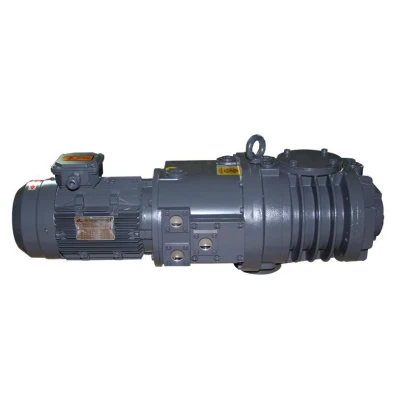
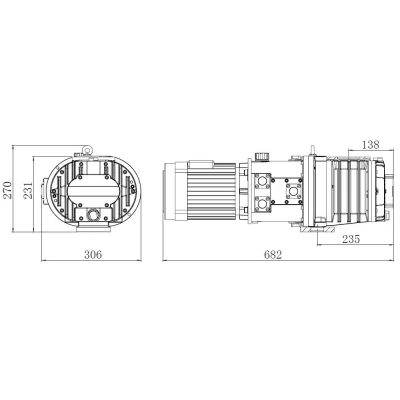
Our Roots Vacuum Pump works differently from a rotary vane pump. The pump chamber has two figure-eight rotors. They rotate in opposite directions at the same speed. The rotors do not touch each other or the chamber wall. A small gap stays between them. Gas enters the inlet. The rotor movement carries the gas through the chamber. The gas gets pushed out the exhaust. Because the parts do not touch, this pump can spin fast. The speed reaches 2900 r/min. That is faster than a rotary vane pump. The body is rectangular. The inlet and outlet sit on top. The flanges are ISO63 and ISO40. ISO flanges are standard. You lock the clamp and the seal is tight. No tape or sealant is needed. We fill the oil seal and gearbox before shipping. You do not need to add oil. Just connect the piping and wire the power.
Double Your Speed with Low Energy Cost
Our Roots Vacuum Pump boosts pumping speed significantly. A rotary vane pump alone might give you 100 m³/h. Add this Roots pump in series and the total speed reaches 250 m³/h. The speed more than doubles. You only add a 2.2 KW pump. This costs less than buying one large pump. A Roots pump cannot work alone. It needs a backing pump. The backing pump pulls the system to a base vacuum first. Then the Roots pump starts. It accelerates the gas removal. We started making Roots pumps in 2015. That same year, we completed mass production of the full LC series. We have updated the design many times. The technology is mature. The flanges are standard for easy installation. The gearbox oil level is calibrated before shipping. Just check the oil sight glass when you install it. Choose a backing pump between 40 and 100 m³/h. If the backing pump is too small, the Roots pump will not perform well. If too large, you waste power. Our engineers can help you calculate the right match.
Central Vacuum and Booster Applications
This Roots Vacuum Pump suits systems where you need high speed but the backing pump alone is not enough. Central vacuum systems are a good example. One workshop may have dozens of machines using vacuum at the same time. The total speed requirement is high. Using only rotary vane pumps is not cost-effective. A Roots pump plus a rotary vane pump works better. Vacuum drying, vacuum distillation, and vacuum coating all use Roots pumps. The most common setup we see is: one single-stage pump for rough pumping, one Roots pump for boosting, and one two-stage pump for high vacuum. These three form a complete system. It gives both speed and depth. We have used this combination in many projects. It runs reliably.
Technical Specifications
|
Parameter |
Value |
|
Model |
DLT.LC250 |
|
Pumping Speed (50Hz / 60Hz) |
250 / 300 m³/h |
|
Motor Power |
2.2 KW |
|
Motor Speed |
2900 r/min |
|
Voltage |
3-phase 220/240V; 380/415/460V |
|
Inlet / Outlet Connection |
ISO63 / ISO40 |
|
Weight |
61 KG |
|
Oil Seal Capacity (pre-filled) |
0.125 L |
|
Gearbox Oil Capacity (pre-filled) |
0.15 L |
|
Noise Level |
70 dB |
Hot Tags: roots vacuum pump, China roots vacuum pump manufacturers, suppliers, factory, Auxiliary Vacuum Pump, Mechanical Booster Pump, roots booster vacuum pump, roots pump, roots type vacuum pump, rotary lobe vacuum pump