

Hey there! As a vacuum pump supplier, I get asked a lot about the maximum vacuum level a vacuum pump can achieve. It's a pretty interesting topic, and I'm excited to share my knowledge with you.
Let's start by understanding what vacuum level actually means. Vacuum is defined as a space devoid of matter, or at least a space with a pressure lower than the atmospheric pressure. The vacuum level is usually measured in units like torr, pascal, or millibar. The lower the pressure, the higher the vacuum level.
There are different types of vacuum pumps, and each type has its own limitations when it comes to achieving a maximum vacuum level. Some of the common types of vacuum pumps include rotary vane pumps, diaphragm pumps, and turbomolecular pumps.
Rotary vane pumps are one of the most widely used types of vacuum pumps. They work by using rotating vanes to create a vacuum. These pumps can typically achieve a vacuum level in the range of 10^-3 to 10^-2 torr. They are great for general-purpose applications where a moderate vacuum level is required, such as in laboratories or small industrial processes.
Diaphragm pumps, on the other hand, use a flexible diaphragm to create a vacuum. They are known for their simplicity and reliability. Diaphragm pumps can usually achieve a vacuum level of around 10^-1 to 10^-2 torr. They are often used in applications where a clean and dry vacuum is needed, like in medical devices or food packaging.

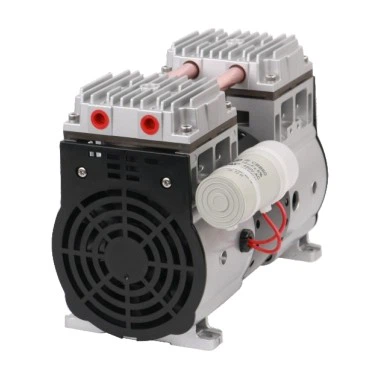
Turbomolecular pumps are high-performance pumps that can achieve extremely high vacuum levels. They work by using high-speed rotating blades to create a vacuum. These pumps can reach vacuum levels as low as 10^-9 torr or even lower. Turbomolecular pumps are commonly used in scientific research, semiconductor manufacturing, and other high-tech applications where a very high vacuum is required.
But what factors affect the maximum vacuum level a vacuum pump can achieve? Well, there are several factors to consider. One of the main factors is the design and construction of the pump. A well-designed pump with high-quality components will generally be able to achieve a higher vacuum level.
Another factor is the type of gas being pumped. Different gases have different properties, and some gases are more difficult to pump than others. For example, noble gases like helium and neon are relatively easy to pump, while gases like water vapor and oil vapor can be more challenging.
The size and capacity of the pump also play a role. A larger pump with a higher pumping speed will generally be able to achieve a higher vacuum level more quickly. However, it's important to note that the maximum vacuum level is also limited by the ultimate pressure of the pump, which is determined by the design and construction of the pump.
Now, let's talk about some of the applications where a high vacuum level is required. One of the most common applications is in the semiconductor industry. In semiconductor manufacturing, a high vacuum is needed to prevent contamination and ensure the quality of the semiconductor chips. Turbomolecular pumps are often used in this industry to achieve the required vacuum levels.
Another application is in scientific research. Many scientific experiments, such as particle accelerators and electron microscopes, require a high vacuum to function properly. Vacuum pumps are used to create and maintain the vacuum environment in these experiments.
In the medical field, vacuum pumps are used in a variety of applications, such as in medical suction devices and dental equipment. Medical Vacuum Pump are designed to provide a reliable and clean vacuum for these applications.
In the food industry, vacuum pumps are used for packaging and preservation. By removing the air from the packaging, the shelf life of the food can be extended. Portable Vacuum Pumps for Milking Cows are also used in the dairy industry to milk cows efficiently.
If you're in the market for a vacuum pump, it's important to choose the right pump for your application. Consider factors such as the required vacuum level, the type of gas being pumped, and the size and capacity of the pump. You may also want to consider the reliability and maintenance requirements of the pump.
As a vacuum pump supplier, we offer a wide range of vacuum pumps to meet your needs. Whether you're looking for a Rotary Piston Vacuum Pump for a small laboratory or a high-performance turbomolecular pump for a large industrial application, we have the right pump for you.
If you have any questions or need help choosing the right vacuum pump for your application, please don't hesitate to contact us. We're here to help you find the best solution for your needs.
In conclusion, the maximum vacuum level a vacuum pump can achieve depends on several factors, including the type of pump, the design and construction of the pump, the type of gas being pumped, and the size and capacity of the pump. By understanding these factors and choosing the right pump for your application, you can achieve the desired vacuum level and ensure the success of your project.
References:
- "Vacuum Technology: A Practical Guide for Scientists and Engineers" by O'Hanlon, J. F.
- "Handbook of Vacuum Physics" by Dushman, S.